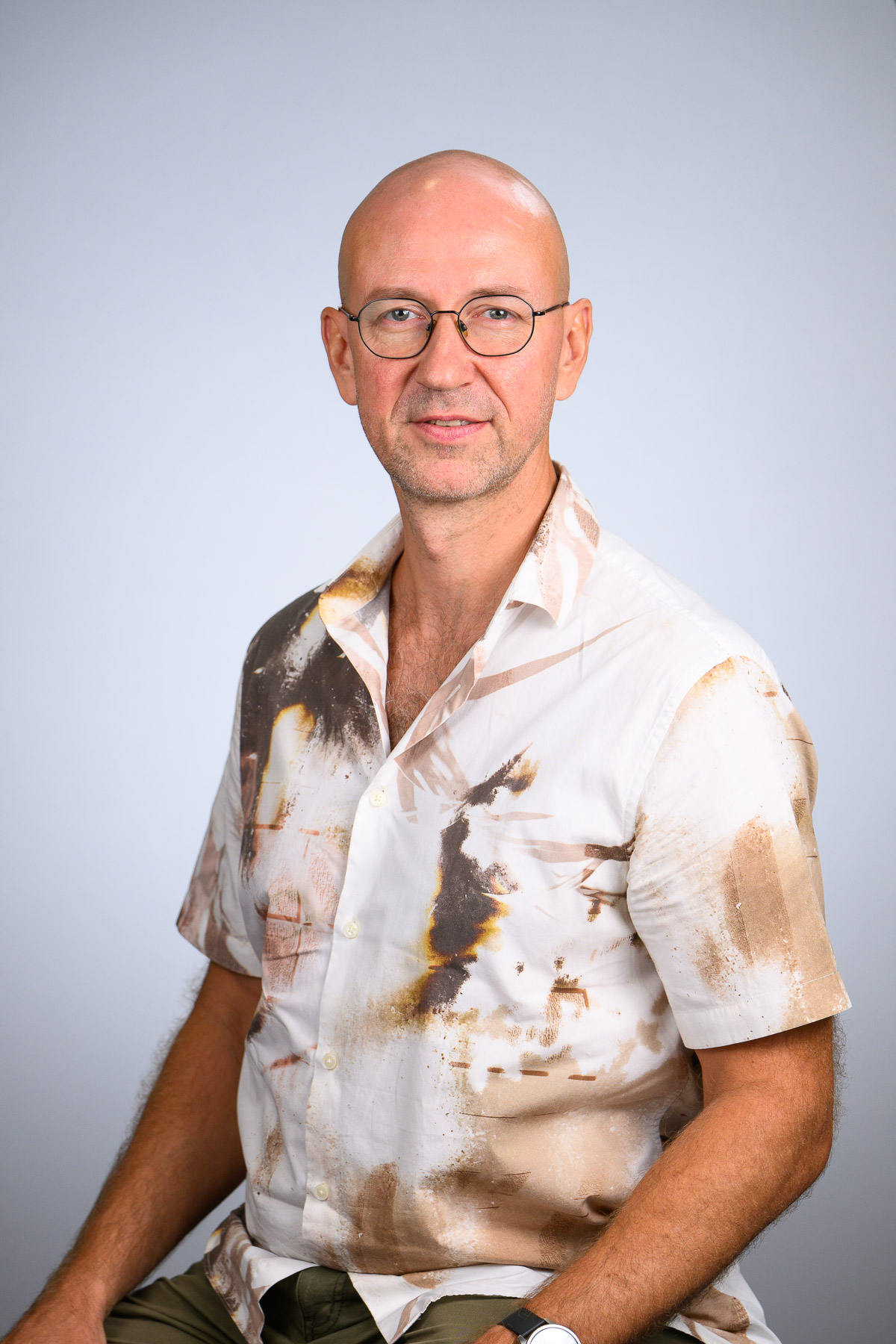
Saulius Geniušas
Chinese University of Hong Kong / Vytautas Magnus University
Short bio:
Saulius Geniusas is Professor of Philosophy at The Chinese University of Hong Kong and Chief Research Fellow at Vytautas Magnus University. He is the author of five single-authored books, nine edited volumes and journals, and over 80 articles and book chapters. His primary expertise lies in post-Kantian European philosophy, particularly in phenomenology and hermeneutics, supplemented by competencies in philosophical anthropology, aesthetics, and the history of modern philosophy. In recent years, his research has centered on affectivity (especially pain), imagination (especially productive imagination), self-awareness (especially displaced self-awareness), and historicity (particularly sedimentation). Recognized as an Outstanding Fellow of the Faculty of Arts at CUHK (2024-29), Professor Geniusas has received multiple international accolades for his work, including the Edward Ballard Prize and the Hermes Award for The Phenomenology of Pain (2020). He is also the recipient of numerous prestigious research fellowships and grants, including a Humboldt Research Fellowship for Experienced Researchers.
Abstract:
The Fractured “We”: The Crisis of Collective Agency in the Digital Age
The contemporary digital landscape presents a striking paradox: a simultaneous proliferation and profound crisis of collective agency. Modern subjects drift fluidly from one digital bubble to another, yet these new modes of collective agency possess no experiential weight, remaining fragile, fleeting, and fragmented. In my talk, I wish to address this contemporary predicament by shifting the debate away from the formalisms of social ontology toward a phenomenological investigation of technology and sociality. Engaging Edmund Husserl’s generative phenomenology, Günther Anders’s critique of media technology, Jan Patočka’s existential politics, and Alphonso Lingis’s ethics, the lecture argues that the digitalization of contemporary existence has structurally severed the generative density required for traditional social unities, leaving us in a state of collective disorientation.
I will begin by recovering Husserl’s concepts of the “homeworld” (Heimwelt) and “homecomrades” (Heimgenossen). For Husserl, genuine collective entities, conceived as members of a “personality of a higher order”, are grounded in a shared, territorially anchored history, sedimented traditions, and intergenerational continuity. I will maintain that digital infrastructure and algorithmic curation have radically disrupted this topography. The contemporary social life can be characterized not by the interaction between Husserl’s Heimgenossen, but by what can be termed, following Anders, Jetztgenossen (now-comrades). In our digitalized world, collective alignment is no longer built on historical and cultural density or geographic proximity, but on temporal synchronization. Engaging Anders’s philosophy of technology, the talk demonstrates how his mid-20th-century diagnosis of broadcast media applies to the algorithmic era. Under the conditions of digital synchronicity, the Jetztgenossen are transformed into networked “mass hermits”: individuals who can experience the same curated events simultaneously, yet remain fundamentally isolated from one another. This superficial synchronization empties collective agency of its existential sense, generating a hyper-proliferation of phantom collectivities that lack the shared normative horizons needed for sustained political or moral action.
In this framework, a reactionary, populist desire to return to a lost, localized world becomes understandable. Yet generative density cannot be artificially reconstituted either through digital or populist means, and this leads to a stark dilemma: if sedimented historical density is gone, what can possibly ground a meaningful collective agency today?
In the last part of my talk, I will turn to Patočka’s concept of the “solidarity of the shaken” alongside Alphonso Lingis’s concept of “the community of those who have nothing in common.” These thinkers offer a model of togetherness born not from shared identity, contracts, or synthetic digital commonalities, but from the raw exposure of bodily vulnerability, finitude, and suffering. When the superficial categories of the “rational community” fracture under historical or technological crisis, subjects encounter one another not as home-comrades, but as compromised strangers bound by a shared existential experience. Ultimately, I contend that this framework offers a much-needed paradigm for a resilient collective agency, one that does not look backward to a romanticized past, but finds its ethical solidarity within the shared fragility of our fractured contemporary world.